
 EN
EN
Why Does an "Oil-Free" Dry-Type Transformer Still Need Fan Cooling?
Published by: Shanghai Angeda
Introduction: A question every buyer asks
When you see a dry-type transformer for the first time, one thing stands out: there is no oil tank. No oil level gauge, no conservator, no radiators, no leak-prone gaskets. So the natural conclusion is, "this transformer needs no cooling at all." Then you look at the base — and there it is: a row of fans bolted beneath the coils.
The question follows immediately: You just told me it is oil-free. So why does it need fans?
This is one of the most common questions in dry-type transformer procurement — and a very good one. The short answer is that "oil-free" describes how the transformer is insulated and cooled, not whether it generates heat. Every transformer generates heat while it works, and that heat must be removed continuously. In an oil-filled unit, the oil carries the heat away. In a dry-type unit, air does the job — sometimes naturally, sometimes with the help of fans.
In this article, we explain the physics behind that answer, why the fans are not a contradiction, and what the "AN/AF" letters on a rating plate really mean for your project.
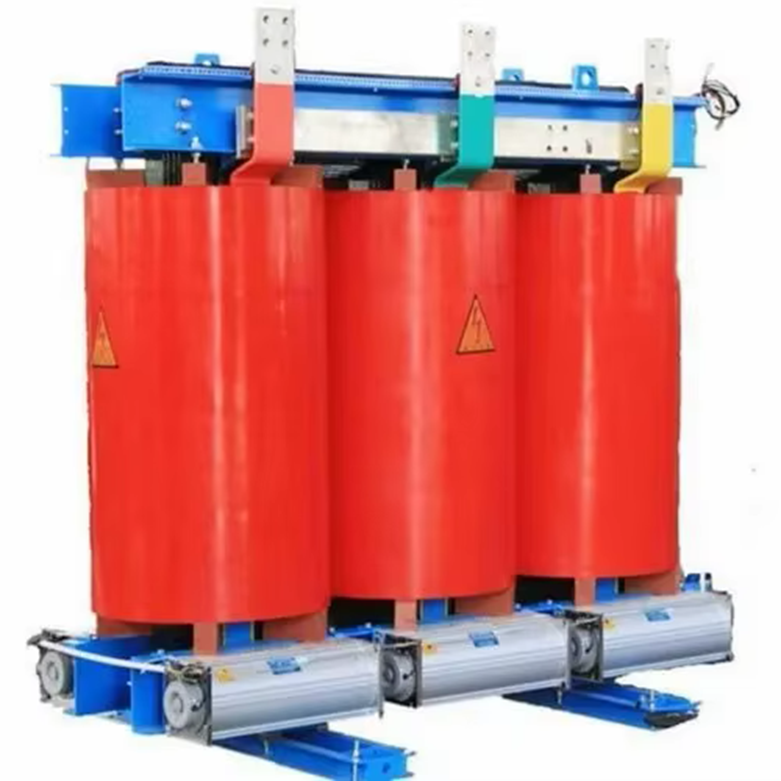
Fans under the coils: the AF system is part of the transformer itself.
Part 1: A transformer is never 100% efficient
No machine converts all the energy it receives into useful work, and a transformer is no exception. Although a well-designed distribution transformer is highly efficient — usually well above 98% at rated load — the small percentage that is lost becomes heat. Two mechanisms dominate:
Iron loss (core loss). Every time the magnetic field in the core reverses direction, a tiny amount of energy is lost — through hysteresis in the steel and through eddy currents induced in the core material. This loss is constant: it exists the moment the transformer is energized, even at no load.
Copper loss (load loss). The windings have resistance, and current flowing through them generates heat according to the I²R relationship. The important part is the square: double the load current, and the copper loss quadruples. Load loss grows fast as the transformer works harder.
Neither of these is a defect. They are the unavoidable physics of electromagnetic conversion. The consequence is that a transformer is always producing heat, and that heat must go somewhere — otherwise the temperature climbs until the insulation is damaged.
Part 2: Heat is the enemy of insulation
Transformer life is, in practical terms, the life of its insulation. The insulation system inside the windings degrades over time, and temperature is the single largest factor in how fast it degrades.
Every insulation system has a thermal class — the maximum hot-spot temperature it can tolerate continuously. F-class insulation, common in dry-type transformers, is rated for a hot-spot temperature of 155 °C; H-class for 180 °C. Beyond these limits, the insulation ages dramatically faster. As a rule of thumb, for every 8–10 °C of sustained temperature rise above the rated value, the aging rate of the insulation roughly doubles. In plain terms: a transformer run a little too hot for a long time can lose decades of design life.
This is where the "dry" part of the dry-type transformer deserves credit. Vacuum-cast epoxy encapsulation protects the windings from moisture, dust, salt, and chemicals, and it is self-extinguishing — a genuine fire-safety advantage over oil. But here is the key point: encapsulation protects the insulation from the environment; it does not remove heat. The thermal energy still has to be carried away from the windings, through the cooling ducts between the coils, and out into the surrounding air.
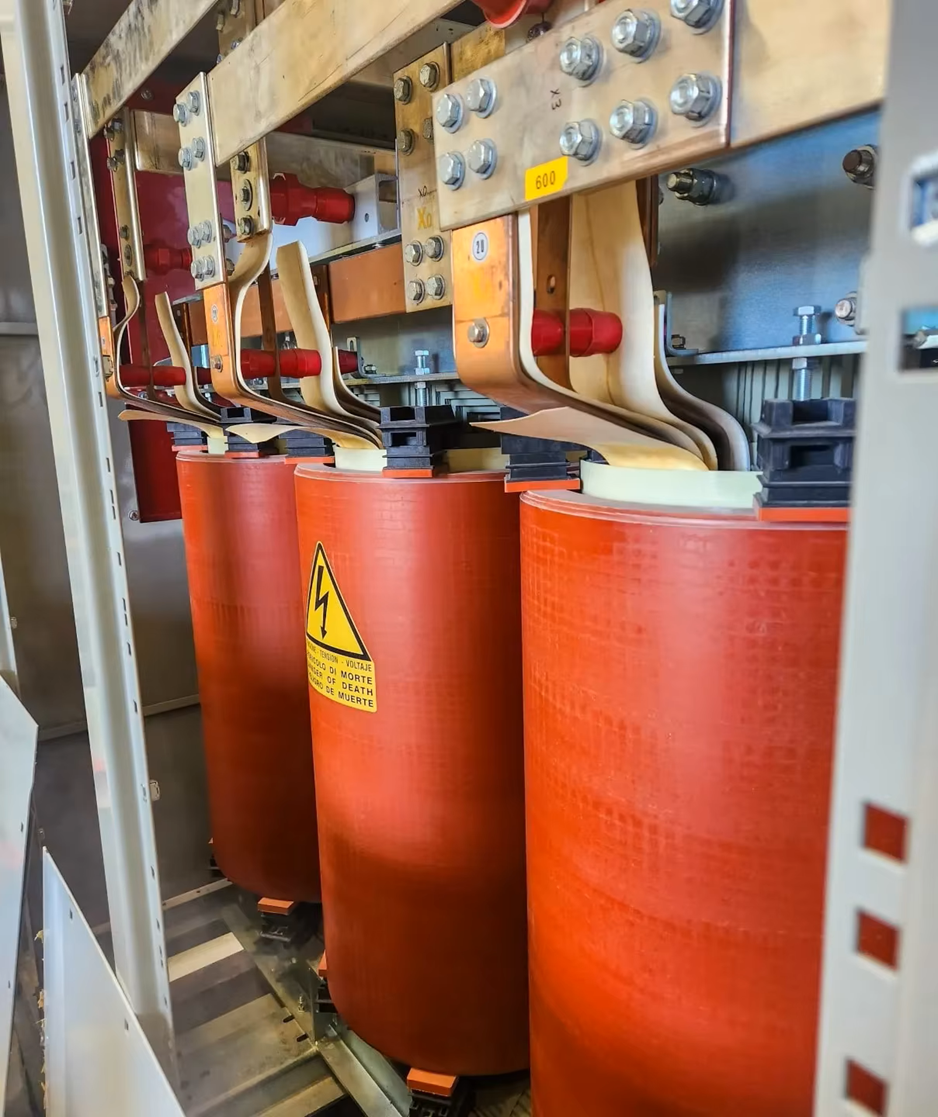
Encapsulated and self-extinguishing — but still producing heat that has to go somewhere.
Part 3: AN — natural air cooling, and where it hits its limit
The simplest way to remove that heat is to do nothing at all: let the air around the transformer warm up, rise, and be replaced by cooler air from below. This is natural convection, and it is the "AN" in AN/AF — Air Natural.
AN cooling is elegant because it has no moving parts: no fans, no bearings, no motors — nothing to wear out or fail. In low-load applications and installations where silence is critical, an AN-only transformer is the right choice. But natural convection is gentle. The amount of heat it can carry away depends on temperature difference and air movement, and it is not enough to sustain a high continuous load.
That is why most dry-type transformers carry two ratings on the nameplate — an AN rating and an AF rating. The AN rating is the continuous load the transformer can carry using natural convection alone. It is the conservative, "always safe" number — and for many buyers, it is not enough.
Part 4: AF — what the fans actually do
The solution is to add energy to the air. That is exactly what a cooling fan does: the rotating blades accelerate the air, creating a pressure difference that drives a continuous, directed airflow through the cooling ducts between the coils.
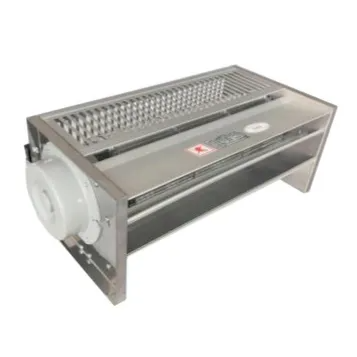
In dry-type transformers, two fan types are common. Cross-flow (tangential) fans — long cylindrical impellers that blow an even sheet of air across the full width of the coil assembly — are widely used in the GFDD-type fan series that sits beneath or beside the windings. Axial fans, mounted at the base, push air upward through the vertical cooling ducts.
The effect is not subtle. Forced airflow removes heat from a hot surface many times faster than natural convection, because it constantly replaces the warm boundary layer of air with cooler air. The result: with the fans running, the transformer can carry a substantially higher continuous load while keeping the winding hot-spot temperature safely within its insulation class. This is the "AF" — Air Forced — rating on the nameplate.
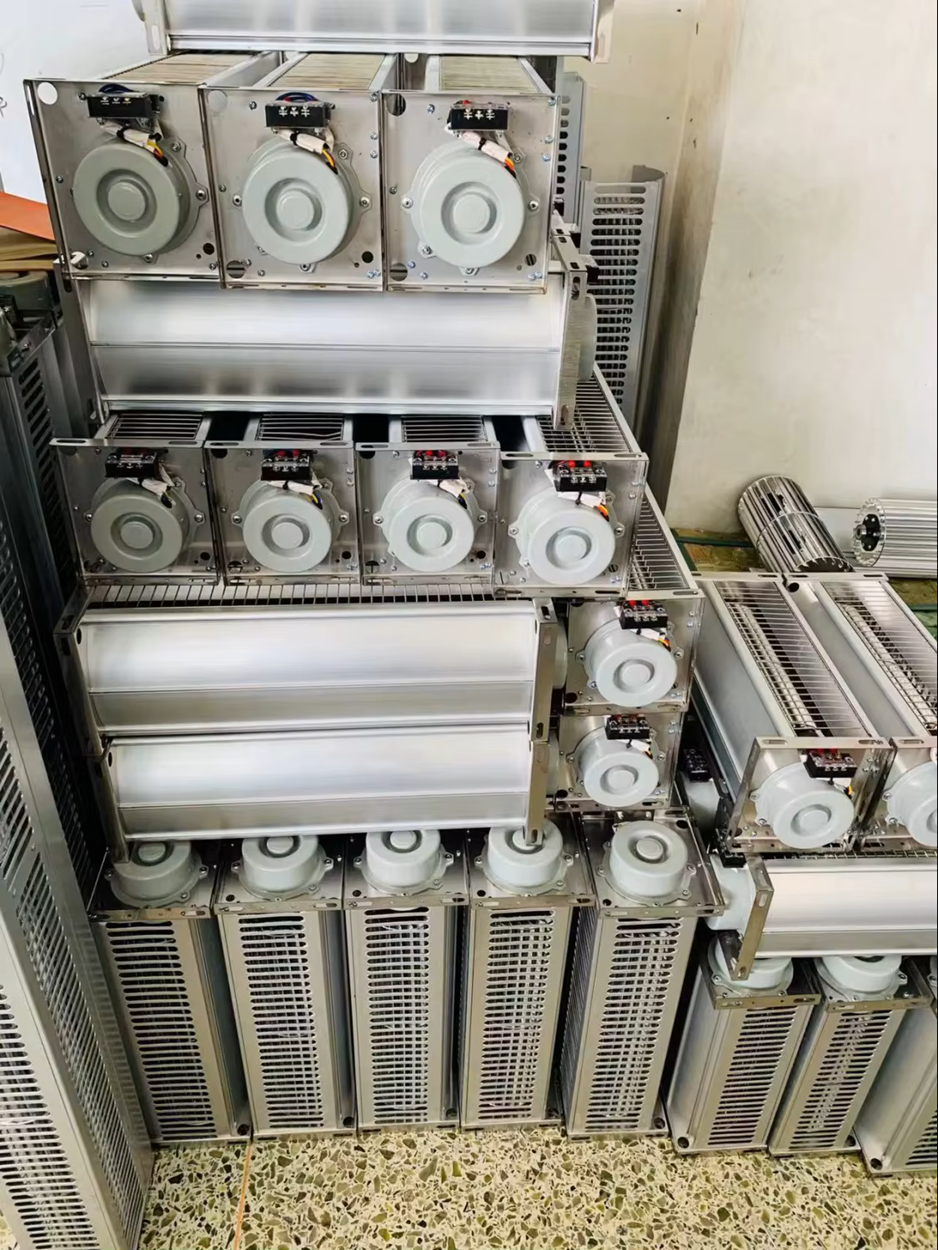
The fan itself: a cross-flow impeller designed to move a large volume of air evenly across the coils.
Part 5: AN and AF working together — the automatic control loop
The interesting part is that AN and AF are not two different products — they are two modes of the same transformer, switched automatically by the temperature control system.
Embedded in the windings are temperature sensors (typically PT100 resistance sensors). A winding temperature controller reads them continuously. Under light load, the temperature stays low and the fans stay off — the transformer runs silently in AN mode. As load rises and the winding temperature crosses the set threshold, the controller starts the fans; the airflow increases and the temperature is held down. When the load drops and the temperature falls below the threshold again, the fans stop.
This closed loop gives the operator the best of both worlds: the quiet, low-maintenance behaviour of AN at partial load, and the high continuous output of AF exactly when it is needed. It also explains the rows of fans under the coils in the photograph at the top of this article: they are the AF system, installed and wired as an integral part of the transformer, ready to be switched on by the controller at a moment's notice.
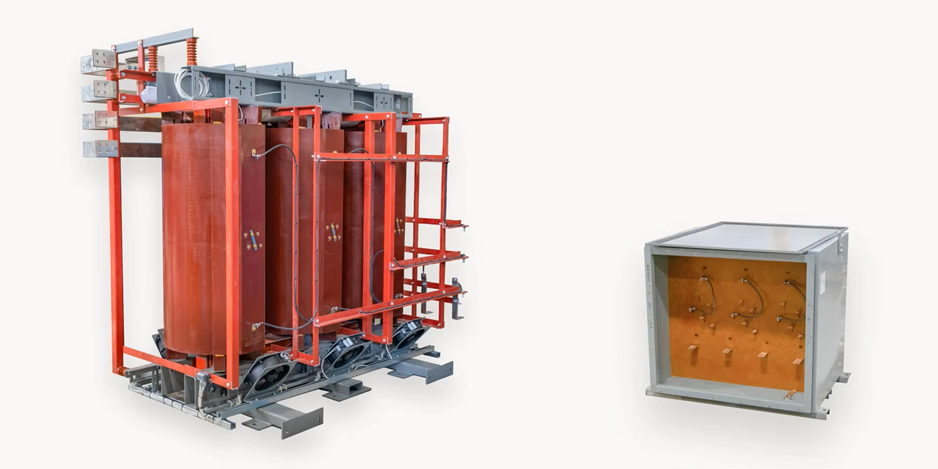
Fans in service position: mounted at the base beneath the coils, wired into the transformer's automatic temperature control loop.
A note for maintenance planners: the fans are, in most dry-type transformers, the only moving parts. They have bearings and motors that will eventually need attention. In continuous-duty installations, spare fan units and a simple inspection schedule are standard practice — and good transformer suppliers design the fan mounting so a unit can be replaced without de-energizing the transformer for long.
Part 6: What this means for you as a buyer
Understanding the AN/AF system changes how you read a quotation and how you specify a transformer:
Read both ratings.
- A transformer is often quoted by its AN/AF rating pair (for example, AN/AF 800/1000 kVA). Make sure the rating you compare is the one that matches your actual duty cycle. If your load profile has short high peaks, the AF rating may cover them without buying a larger frame.
Check the control system.
- Confirm the unit comes with winding temperature control and that the fan switching thresholds are set correctly for your ambient conditions.
Consider the environment.
- Both ratings assume a reference ambient temperature and altitude; hot rooms and high-altitude sites derate the transformer, and the fans work harder. The derating rules should be stated in the supplier's technical documentation.
Plan for the fans.
- They are the only consumable part. Budget for spare fan units and periodic inspection — a small cost compared with the flexibility the AF rating buys.
Remember the benefits of "dry".
- The fan does not change the dry-type value proposition: no oil to leak, no oil to sample and filter, no fire risk from oil, compact footprint, and easier indoor installation. The fan simply removes the heat that the oil would have removed in a conventional unit.
Conclusion: oil-free does not mean heat-free
The apparent contradiction resolves cleanly once you separate two ideas. "Oil-free" describes the insulation and cooling medium: epoxy, air, and fire safety instead of oil. "Fans" describe the cooling method: active airflow instead of passive convection. One does not cancel the other — they work together.
The fans under a dry-type transformer are not a sign that the design is flawed, and they are not an optional extra. They are the mechanism that turns a quiet, conservative AN machine into a flexible AN/AF machine that can carry heavy load when it must and run silently when it can. Understanding that is the difference between choosing a transformer by nameplate and choosing it by physics — and the physics is what keeps your installation running cool, and running long.
Suggested SEO Meta
Meta title:
- Why Does an "Oil-Free" Dry-Type Transformer Still Need Fan Cooling? | Shanghai Angeda
Meta description:
- Dry-type transformers are oil-free — so why do they still come with cooling fans? The physics of AN/AF cooling, heat and insulation life, explained for B2B buyers.
Keywords:
- dry-type transformer, cast resin transformer, AF cooling fan, AN/AF rating, transformer cooling, cross-flow fan, winding temperature, Shanghai Angeda
Table of Contents
- Why Does an "Oil-Free" Dry-Type Transformer Still Need Fan Cooling?
- Introduction: A question every buyer asks
- Part 1: A transformer is never 100% efficient
- Part 2: Heat is the enemy of insulation
- Part 3: AN — natural air cooling, and where it hits its limit
- Part 4: AF — what the fans actually do
- Part 5: AN and AF working together — the automatic control loop
- Part 6: What this means for you as a buyer
- Conclusion: oil-free does not mean heat-free